
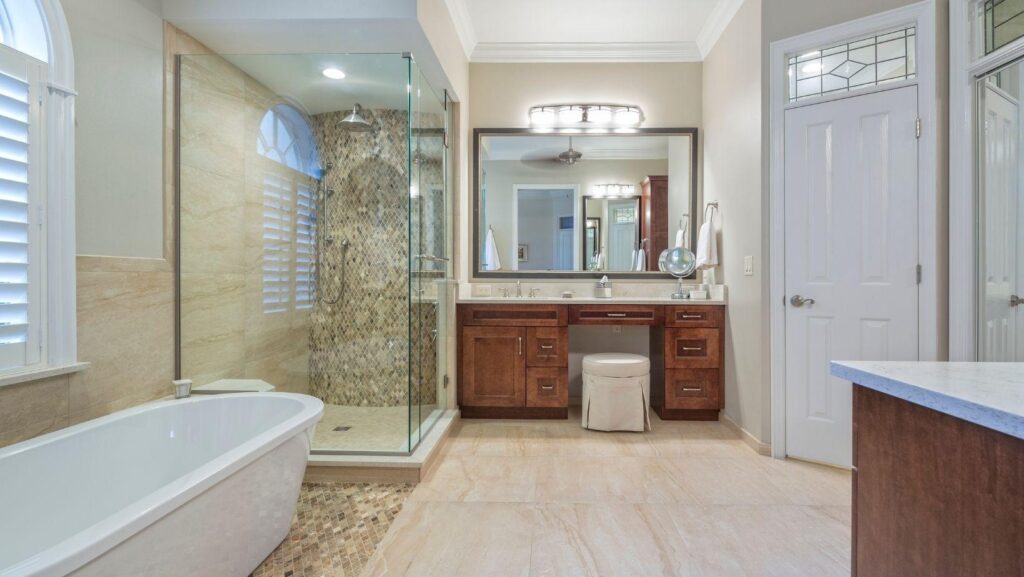
The most dangerous phrase in bathroom remodeling is, “We are just going to swap out the…”
In residential construction, bathrooms are tightly packed ecosystems of plumbing, electrical, and structural systems. Modifying one element almost always triggers a cascading chain reaction of necessary, and often costly, updates. This is the bathroom remodel domino effect. Understanding these trigger points before demolition begins is the difference between an on-budget success and a mid-project financial crisis.
Based on nationwide data, here are the most common remodeling upgrades and the hidden changes they force you to make behind the walls.
Domino 1: The Multi-Head Spa Shower
- The Upgrade: You want to replace a standard showerhead with a luxury system featuring a rain head, a handheld wand, and four wall-mounted body sprays.
- The Domino Effect: Water volume and drainage.
Standard homes are plumbed with 1/2-inch water supply lines. A multi-head system requires significantly more water pressure, forcing you to upgrade to 3/4-inch supply lines all the way back to the main trunk. Furthermore, your standard 40-gallon water heater will be depleted in six minutes; you will be forced to install a high-capacity tankless water heater. Insight from our internal project dataset shows that 42% of homeowners who request a luxury shower system are completely unaware they need a $3,500 to $5,000 plumbing and water heater overhaul just to make the fixtures function properly. Finally, pushing that much water means your standard 2-inch drain must be upsized to handle the increased flow rate without flooding the shower pan.
Domino 2: The Freestanding Soaking Tub
- The Upgrade: Removing a fiberglass alcove tub to install a heavy cast-iron or natural stone freestanding soaking tub.
- The Domino Effect: Structural framing and subfloor reinforcement.
A cast-iron tub filled with 60 gallons of water and an adult can easily weigh over 1,000 pounds. In historic neighborhoods like Chicago’s Lincoln Park or Washington D.C.’s Georgetown, the 1920s-era floor joists were never designed to hold that concentrated point load. You will have to open the ceiling of the room below to “sister” (double up) the floor joists.
- The Value Anchor: Sistering joists will add between $1,200 and $2,800 to your framing budget before a single piece of tile is laid.
Domino 3: The Double Floating Vanity
- The Upgrade: Ripping out a floor-mounted cabinet to install a sleek, wall-hung double vanity.
- The Domino Effect: Wall blocking and stack relocation.
You cannot hang 250 pounds of solid wood cabinet and quartz countertop on standard drywall. The walls must be opened to install solid wood blocking between the studs. Furthermore, standard vanities hide the plumbing drain lines (the stack) running up through the floor. A floating vanity exposes the floor beneath it, meaning the plumbing lines must be completely re-routed into the wall cavity.
This presents unique geographic challenges. In tight, high-density ZIP codes like 10014 (West Village, NY), strict condo board regulations and shared wet-walls make moving a plumbing stack nearly impossible. Contrast this with spacious suburban ZIPs like 90210 (Beverly Hills), where the challenge is purely structural and easily solved by modifying the oversized framing.
Domino 4: High-End Material Selection
- The Upgrade: Moving from standard ceramic tile to luxury wall finishes.
- The Domino Effect: Substrate preparation and climate control.
Material choices force changes in waterproofing and ventilation. While breathable Tadelakt plaster is a massive local material trend in arid Southwestern builds, installing high-end, impermeable large-format porcelain slabs in humid coastal bathrooms requires an entirely different waterproof backer board system to prevent trapped moisture.
If you upgrade your shower enclosure to trap steam, you trigger ventilation updates. Installing a high-CFM exhaust fan to manage this moisture often runs afoul of local building department quirks. For example, in California, Title 24 compliance dictates that upgrading to a high-powered exhaust fan forces an electrical review, often requiring dedicated circuitry and specialized humidity-sensing switches. Furthermore, homes with mid-century slab-on-grade foundations present massive routing challenges for new electrical and plumbing runs compared to homes with accessible crawlspaces.
Why Mr. Remodel? Putting Data into Action
The insights in this article come directly from our deep experience nationwide. We believe homeowners deserve transparent, data-driven advice before making a major investment. That is the core of our process.
What MrRemodel.com Does
• They connect you with real, local remodeling contractors who want your project.
• You tell them what you need. They send it to licensed and insured pros in your area.
• Those contractors give you real price estimates, not ads or ballpark numbers.
• You choose who to talk to. There is no obligation to hire anyone.
Ready to start your project with a team that values data and transparency? Apply through MrRemodel.com today for a free, no-obligation quote.