
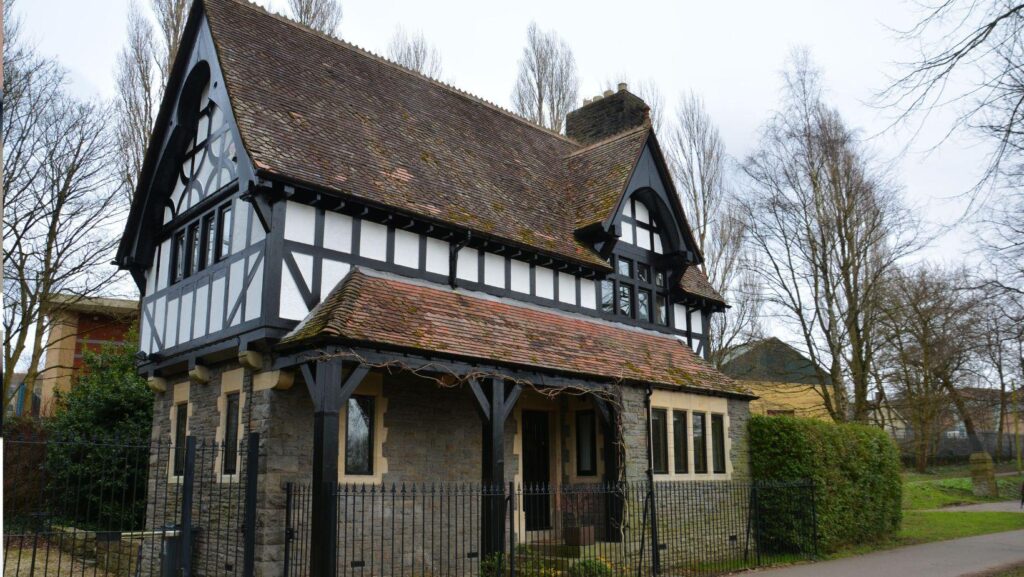
There is something happening in residential real estate that the new construction numbers do not capture. Buyers who spent years scrolling past historic homes are now circling back. Tudor Revival homes, with their steep rooflines, half-timbered facades, arched doorways, and leaded glass windows, are drawing serious interest from buyers who want a home that looks and feels like nothing else on the street.
This is not nostalgia for its own sake. It is a reaction to a decade of interchangeable gray-and-white new builds. Tudor homes offer architectural character that cannot be replicated at scale, and buyers in markets where this stock exists are beginning to understand that scarcity has real value. According to Bob Vila, Tudor homes typically command a price premium of 10 to 20 percent over similar-sized contemporary homes in the same neighborhood, a reflection of their craftsmanship, historical charm, and relative scarcity. The National Trust for Historic Preservation has also documented a growing buyer preference for heritage architecture as a direct reaction to the dominance of modern forms in new construction over the past decade. The neighborhoods where Tudors concentrated, built mostly between 1910 and 1940, tend to be walkable, tree-lined, and close to established commercial corridors. That combination is proving harder to find, and more valuable, than it once seemed.
The agents and brokerages who work these markets regularly see it firsthand. Here are the teams across the US who know Tudor homes best and the markets where that expertise matters most.
1. Salgado Real Estate Group — Portland, Oregon
Portland’s Irvington and Laurelhurst neighborhoods are among the most intact Tudor Revival corridors in the Pacific Northwest. Salgado Real Estate Group has built its practice around historic homes in these districts, where steeply pitched gables and original brick detailing define entire blocks. Portland’s Tudors tend to be well preserved relative to other markets, and buyers working with agents who understand the specific maintenance considerations, original window systems, masonry care, and period-appropriate renovation, move through the process with far fewer surprises.
2. Get Happy at Home — Seattle, Washington (Ravenna)
For buyers looking to explore Ravenna Seattle living, this is one of the most concentrated pockets of Tudor and Craftsman housing stock in the city, and Get Happy at Home has deep familiarity with what makes these homes trade the way they do. The neighborhood’s tree-lined streets, strong school reputation, and proximity to University Village and Green Lake have made it one of Seattle’s most consistently desirable addresses. Tudors here are cozy without feeling cramped, and the pre-war construction quality, old-growth fir floors, original built-ins, and thick plaster walls, holds up in ways that newer builds simply do not. For buyers serious about historic character in Seattle’s northeast, this is the team that knows the inventory.
3. JohnHart Real Estate — Los Angeles, California
Los Angeles has a larger Tudor Revival inventory than most buyers realize, concentrated in neighborhoods like Los Feliz, Hancock Park, and parts of Pasadena. JohnHart Real Estate is one of the top five brokerages in Greater Los Angeles by volume and has written extensively about what Tudor buyers in the LA market should expect, specifically the balance between the home’s irreplaceable charm and the practical realities of owning a structure built nearly a century ago. Their agents work regularly with buyers who have their heart set on the style and need guidance navigating the inspection process, renovation tradeoffs, and insurance considerations specific to older construction.
4. Cummings and Co. Realtors — Baltimore, Maryland
Baltimore is one of the great underappreciated Tudor markets in the country. Roland Park, Guilford, and Homeland contain block after block of English Revival architecture built in the early twentieth century, and Cummings and Co. Realtors is one of the most active brokerages in those neighborhoods. The Tudor stock here tends to be larger than comparable homes in Pacific Northwest markets, and entry prices remain accessible relative to the architectural quality on offer. For buyers interested in the style but priced out of coastal gateway cities, Baltimore represents one of the more compelling cases for Tudor investment in 2026.
5. Triangle House Hunter — Durham and Chapel Hill, North Carolina
North Carolina’s Research Triangle has a quieter Tudor story than most buyers expect. Durham and Chapel Hill contain solid concentrations of late 1920s and 1930s English Revival homes, particularly in the historic neighborhoods closest to Duke University and UNC. Triangle House Hunter has built its practice specifically around this inventory, helping buyers understand what distinguishes authentic period construction from later Tudor-influenced builds. The market here combines genuine historic character with the kind of job market stability that supports long-term property values.
6. Chicago’s Property Shop — Chicago, Illinois
Chicago’s North Shore suburbs, particularly Evanston, Wilmette, and Kenilworth, contain some of the finest Tudor Revival architecture in the Midwest. Built during the height of the style’s American popularity in the 1920s and 1930s, these homes were constructed with the kind of material quality that reflects the economic confidence of the era. Chicago’s Property Shop works regularly in this corridor and understands the specific considerations that come with masonry-heavy construction in a climate with significant freeze-thaw cycles. For buyers drawn to the style, the Chicago market offers scale and grandeur that Pacific Northwest and East Coast inventories rarely match at comparable price points.
The Broader Shift
What connects these markets is something more than architectural preference. Tudor homes concentrate in neighborhoods that were developed thoughtfully, with mature trees, setbacks, and walkable streets built in from the start. Those conditions do not get recreated easily. Buyers who understand that are approaching Tudor inventory not just as a style choice but as a long-term bet on the kind of neighborhood character that tends to hold value through market cycles. The agents and brokerages who work these markets daily are the ones best positioned to help buyers find the right home, price it correctly, and understand what they are actually getting.