
When choosing a compliance partner for the Façade Inspection & Safety Program (FISP), building owners should determine whether the firm acts as a full risk and repair manager instead of only an inspection company. Owners should review the qualifications and direct role of a licensed Qualified Exterior Wall Inspector (QEWI), the firm’s experience with the building’s specific exterior wall system, its knowledge of NYC Department of Buildings (DOB) filing deadlines, its hands-on inspection methods, and its ability to manage repairs, permits, and amended sign-offs through final regulatory approval.
When choosing a compliance partner for the Façade Inspection & Safety Program (FISP), building owners should determine whether the firm acts as a full risk and repair manager instead of only an inspection company. Owners should review the qualifications and direct role of a licensed Qualified Exterior Wall Inspector (QEWI), the firm’s experience with the building’s specific exterior wall system, its knowledge of NYC Department of Buildings (DOB) filing deadlines, its hands-on inspection methods, and its ability to manage repairs, permits, and amended sign-offs through final regulatory approval.
Managing exterior maintenance in New York City calls for strong technical planning. Selecting dependable Local Law 11 services in NYC helps protect property value, limits the risk of serious fines for owners and boards, and supports pedestrian safety across the city’s nearly 16,000 covered properties. As city reviews become stricter about sidewalk shed timeframes and inspection standards, choosing the right partner is one of the key operating decisions for a property owner or co-op board.
A quick visual walk-around or a low-cost report that overlooks hidden structural damage can lead to growing city fines, canceled insurance, and emergency scaffolding orders. By carefully reviewing engineering credentials, filing skills, and the ability to manage repairs from start to finish, building owners can protect their property from expensive compliance problems.
What Should Building Owners Evaluate When Choosing Local Law 11 Services?
Licensed New York State Professional Engineers and Registered Architects
The first qualification for any Local Law 11 provider is the credential of the professional who performs and seals the required examination. Under NYC Department of Buildings rules, only a Qualified Exterior Wall Inspector (QEWI)-a licensed New York State Professional Engineer (PE) or Registered Architect (RA) with suitable exterior wall experience-may certify a FISP technical compliance report. Building owners should confirm that the person signing the filing takes part directly in the physical inspection instead of assigning field work to junior employees without proper supervision.
Owners should also review the insurance carried by both the firm and the QEWI. DOB rules require approved inspection agencies to carry general liability insurance, while individual QEWIs must carry errors and omissions or professional liability coverage. Falling debris, balconies, and parapets can create major risks in busy city areas, so boards should confirm that policy limits provide enough protection for possible project claims and go beyond basic legal requirements.
Relevant NYC Façade Experience and Repair Experience
Exterior wall systems do not all have the same problems, and general architectural design experience does not equal specialized façade knowledge. A provider that mainly works on modern curtain walls may not have the skills needed to inspect rusted structural steel shelf angles behind 1920s brickwork or the fragile anchors used on historic terra-cotta cornices. Owners should review the individual QEWI’s project history and look for work on buildings with similar construction types, heights, and landmark rules.
Knowledge of NYC’s different local conditions and building periods gives an inspector useful background during the review. An experienced façade specialist can spot signs of freeze-thaw masonry damage, failing lintels, or damaged parapet flashing before these problems become public safety hazards. Reviewing the consultant’s work on similar historic or modern buildings can lead to more accurate findings and practical repair plans.
Knowledge of DOB Filing Rules and FISP Deadlines
DOB NOW: Safety follows strict filing rules. FISP operates on five-year cycles that are divided into sub-cycles based on the last digit of a property’s block number. Missing a deadline can lead to immediate and continuing civil penalties, including late filing fees of $1,000 per month and added yearly penalties for failure to file. An experienced provider uses internal tracking systems to meet each deadline well before the filing period ends.
Knowledge of the rules also matters when unsafe conditions need quick action. If an Unsafe condition is found, the owner must provide immediate notice and protection, beginning strict 90-day periods for repair work and permit progress. A qualified team knows how to prepare FISP extension filings correctly, reduce the risk of technical rejections, and avoid administrative errors that may lead to city summonses.
Inspection Methods, Access Equipment, and Safety Procedures
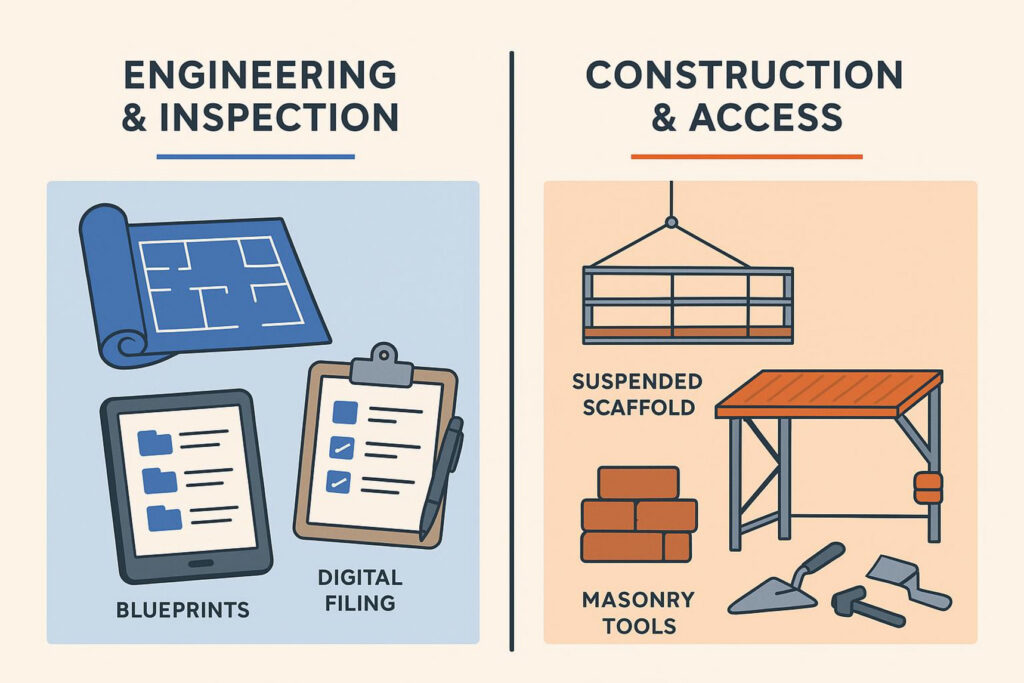
A full façade review cannot be completed only from the sidewalk with binoculars or telephoto lenses. High-resolution cameras and drones can help with an initial review of large towers, but city rules require hands-on close-up inspections along assigned façade drops. Owners should review the provider’s plan for using suspended scaffolds, motorized pipe scaffolding, boom lifts, or industrial rope access.
Safety during these access operations is a major concern. The provider should use clear Site Safety Plans, documented fall-arrest training, and certified rigging methods. Ask how the team will protect pedestrians and occupants while workers are suspended above the sidewalk. Confirm that the firm follows clear procedures for tactile sounding and exploratory probe openings.
Quality of Reports, Photographs, and Supporting Documentation
The technical filing given to the board and the city must be accurate, detailed, and able to stand up to review. FISP reports with unclear defect descriptions, poorly marked elevations, or low-quality photographs are often returned by DOB plan examiners with formal objections. These rejections can delay approval and leave the building under continued city review.
Owners should ask potential consultants for samples of past Cycle reports with private information removed. Good reports include clear elevation maps that identify cracks, spalls, movement, and failed joints. They should also contain photographs with location data, material condition ratings, and clear engineering reasons for classifying elements as Safe, Safe with a Repair and Maintenance Program (SWARMP), or Unsafe.
Ability to Coordinate Repairs, Permits, and Final Filings
Finding an exterior defect is only the first part of the compliance process. The problem must also be repaired under city codes. A full-service Local Law 11 provider should have the engineering skills to prepare repair drawings, write specifications, and handle DOB plan reviews for construction permits. Without one team managing both the inspection and repair work, gaps can develop between the engineering report and the contractor’s work.
After construction ends, the property does not automatically return to a compliant status. The provider must perform follow-up inspections and prepare and submit amended FISP technical reports to close violations. A firm that manages the full regulatory process can help keep sidewalk scaffolding in place only for the time needed.
Responsiveness, Communication, and Board or Owner Support
Façade repairs can interrupt normal building operations and affect unit owners, retail tenants, and co-op or condo shareholders. Lost terrace access, blocked window views caused by sidewalk sheds, and construction noise may create complaints. A qualified provider should communicate well and explain technical findings in clear language to board members and property managers without engineering backgrounds.
Unexpected problems can appear during a probe cut, such as widespread hidden corrosion in structural steel. The engineer must respond quickly when this happens. Look for firms that provide regular weekly updates, attend board meetings when requested, and communicate fairly with contractors, residents, managing agents, and city inspectors.
Which Local Law 11 Services Should a Qualified Provider Offer?
Initial Façade Condition Assessment
A reliable compliance program starts with a detailed review of documents and visible conditions. Before expensive rigging equipment is brought to the site, the engineering team should review earlier FISP filings, repair drawings, violation records, and maintenance logs. This review can identify repeated problem areas and patterns of damage across the building’s exterior elevations.
This early stage includes street-level visual reviews, telephoto photographs, and a meeting with property staff to confirm the work scope. By reviewing earlier repair projects and available building drawings, the provider can create an inspection plan focused on higher-risk features and arrange field access in an efficient way.
Close-Up Inspections and Hands-On Testing
NYC Building Code rules require a QEWI to perform physical hands-on reviews along representative exterior drops from the roofline to the street. During these drops, the inspector checks masonry, parapet walls, fire escapes, lintels, terra-cotta features, and window frame connections. The inspector uses hand tools such as hammers to find hollow-sounding or separated masonry below the surface.
If deeper damage may be present, an experienced provider like Nova Construction Services should carry out focused testing. This may include masonry probes, borescope inspections, mortar testing, and moisture tracing. These methods show the condition of concealed structural steel, relieving angles, cavity ties, and waterproofing membranes that cannot be judged through a surface-only review.
FISP Technical Report Preparation and DOB Submission
After the field work, the provider prepares the FISP Technical Report for electronic submission through DOB NOW: Safety. The report records the condition of all exterior walls, attachments, balconies, and setbacks. It assigns one of three city classifications: Safe, SWARMP, or Unsafe.
A Safe classification means that no structural or safety defects were found. SWARMP means that the conditions do not currently threaten pedestrians but could become dangerous before the next five-year cycle if they are not corrected. The report must include clear repair recommendations, expected correction dates, and an organized set of photographs that meets city documentation rules.
Unsafe Condition Reports and Emergency Coordination
If the inspector finds an immediate hazard, such as a loose brick cornice above an entrance or a cracked and displaced parapet wall, the provider must follow emergency procedures. City rules require the QEWI to promptly file a FISP2/FISP3 Notification of Unsafe Conditions with the Department of Buildings and advise the owner about immediate protection measures.
The provider must arrange urgent public safety work, which may include a fast sidewalk shed installation, safety netting, or pedestrian bridge barricades around the danger area. A firm with 24/7 emergency response procedures can protect people while helping the owner avoid emergency stop-work orders and serious city liability.
Repair Design, Bid Support, and Construction Administration
SWARMP and Unsafe conditions require accurate engineering plans. A full-service firm prepares architectural details, structural repair drawings, structural calculations, and technical specifications for contractor pricing and DOB alteration permits. Clear construction documents reduce confusion in bids and help protect owners from unexpected change orders.
During bidding and construction, the provider reviews and compares contractor proposals to confirm that each one matches the planned work. As repairs move forward, the engineer makes regular site visits to review mortar mixes, flashing, structural pin installation, and waterproofing. These visits help confirm that the contractor follows the approved drawings.
Amended Filings, Sign-Offs, and Ongoing Compliance Tracking
The Local Law 11 process does not end when the restoration contractor removes its tools. After the physical repairs are complete, the QEWI must return to the façade access areas for formal closeout inspections. The inspector confirms that each reported defect was corrected according to the approved engineering plans.
The provider then prepares and submits an Amended FISP Report to the Department of Buildings, asking the city to change the building’s status from Unsafe or SWARMP to Safe. The firm should follow the submission until DOB approves the amended status. This approval allows the owner to remove sidewalk sheds lawfully and return the property to full regulatory compliance.
How Should Owners Compare Local Law 11 Proposals and Costs?
What the Inspection Fee Includes
When reviewing service proposals, owners should look beyond the first price and compare each line of the work scope. An unusually low inspection fee may mean that required services are left out. These services can include DOB filing administration, special testing, probe supervision, or follow-up visits to review contractor repairs.
Ask whether the base proposal includes preparation and electronic submission of the full technical report or only the collection of field information. The contract should state how many visual drops are included, how much time is set aside for board meetings, and whether the fee covers responses to the first plan examiner objections. If not, ask how hourly charges will apply.
Whether Scaffolding, Suspended Scaffolds, or Other Access Costs Are Included
Physical access is one of the largest cost areas in a Local Law 11 inspection. Some engineering firms offer a complete price that includes motorized suspended scaffolding, rigger setup, roof anchor testing, and special rigging labor. Other firms charge only for engineering services and require the owner to hire a separate scaffold contractor.
Unclear access costs can create large differences between bids. Owners should confirm whether rigging permits, sidewalk shed permits, safety drop lines, and roof rigging tie-off certificates are included. Reviewing these details early helps prevent surprise mobilization charges and equipment rental bills during the inspection.
Repair Estimates Versus Inspection and Filing Fees
Building owners should separate inspection and consulting fees from later construction costs. Some full-service restoration companies provide engineering design and construction work under one company. Independent engineering consultants usually keep their services separate from the contractor and charge for design, inspection, and project administration.
A single-company contract can make coordination easier, but owners should require a clear breakdown of the QEWI’s professional fees, physical labor, masonry materials, and access equipment. Separate accounting supports fair construction bidding, reduces conflict-of-interest concerns, and gives the board a clear view of the actual repair costs.
Project Schedule, Deliverables, and Payment Terms
The contract should set clear dates that match city deadlines. Compare proposals by reviewing the promised time for draft inspection reports, final DOB NOW submissions, and repair drawing packages after field conditions are confirmed. Long delays may cause a building to miss its required five-year filing period.
Payment terms should be tied to completed work instead of large advance retainers without clear milestones. A payment plan may include an initial amount when access work begins, a partial payment after the field inspection, and a final balance after DOB accepts the report. This structure supports vendor accountability and keeps the project moving.
Why the Lowest Bid May Not Provide the Best Value
For exterior wall work in New York City, choosing the lowest bidder can sometimes create the highest total cost for an owner or board. Low-fee providers may perform short inspections that miss hidden masonry damage. Those conditions can continue to worsen and later turn unresolved SWARMP items into expensive Unsafe violations. Firms with limited staff may also lack the filing support needed to answer objections quickly, leading to steep city penalties.
A risk-based cost review should include the full project cost: inspection fees, access equipment, permits, tenant disruption, and possible delay fines. Hiring a firm that prepares accurate repair drawings, provides strong construction oversight, and obtains prompt DOB sign-offs can reduce scaffold rental time, limit growing city penalties, and protect the property’s physical condition and long-term value.