
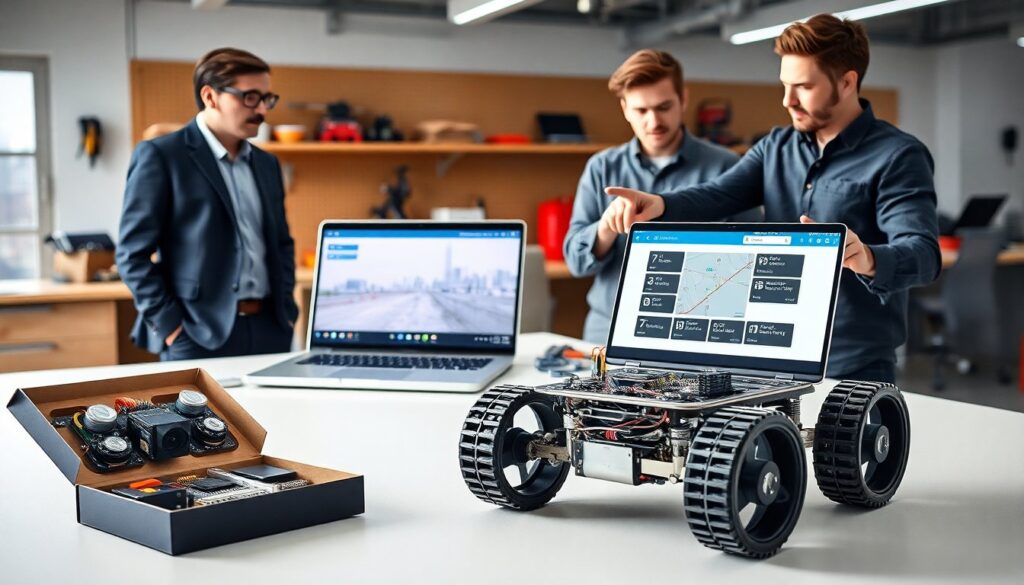
The DIYWorld4Life project tracking diyworlld4life robot buy review starts with one fact: it targets hobbyists and small teams. It uses open hardware and a simple app. It costs less than many ready-made robots. This review examines features, setup, tracking accuracy, and battery life. It also weighs real-world trade-offs. The goal is clear advice for buyers in 2026.
Key Takeaways
- The DIYWorld4Life project tracking diyworlld4life robot buy review highlights its appeal to hobbyists and small teams seeking an affordable, open-hardware tracking robot kit.
- Setup requires about 75 minutes with basic soldering skills, making it a practical learning tool rather than a plug-and-play device.
- The robot achieves 8–12 cm tracking accuracy indoors, improving with good lighting thanks to its camera-based system.
- Battery life runs approximately 2.5 hours under moderate use, with a two-hour charging time, balancing performance and cost effectively.
- Pros include low price and modular sensor support, while cons involve build time and limited out-of-the-box accuracy, especially in low light.
- This robot suits users who value hands-on tuning and community support over commercial-level polish and reliability.
What Is the DIYWorld4Life Project-Tracking Robot and Who Is It For?
The DIYWorld4Life project tracking diyworlld4life robot buy review defines the product as a DIY mobile robot kit. It ships with a chassis, motor drivers, a main board, and sensors. It targets makers, students, and small teams who want a low-cost tracking platform. It suits users who want to learn hardware and software by doing. It does not suit people who want a polished plug-and-play solution. It rewards patience and basic soldering skills. It also supports community firmware and third-party modules for expansion.
Key Features & Technical Specs
The DIYWorld4Life project tracking diyworlld4life robot buy review lists the core specs up front. The robot uses a 32-bit microcontroller with Wi‑Fi and Bluetooth. It carries a 2MP camera, ultrasonic ranger, IMU, and wheel encoders. It weighs about 1.1 kg and measures 28 x 18 x 12 cm. It accepts 7.4V Li-ion packs. It offers GPIO, I2C, and serial ports for sensors. It supports OTA firmware updates. It has a modular plate system for mounts and accessories. It ships with basic fasteners and wiring.
Performance: Setup, Tracking Accuracy, and Battery Life
The DIYWorld4Life project tracking diyworlld4life robot buy review tested setup speed and tracking accuracy. The kit took about 75 minutes to assemble for a first-time builder. The app guided calibration and encoder setup. The robot tracked predefined paths with 8–12 cm average error on flat indoor floors. The camera‑based tracking improved accuracy with proper lighting. The battery ran for about 2.5 hours on moderate duty with the included 2200 mAh pack. Heavy processing tasks cut runtime to about 90 minutes. Charging took roughly two hours from empty.
Pros and Cons — Real-World Trade-Offs
The DIYWorld4Life project tracking diyworlld4life robot buy review found clear pros and cons. Pros: low cost, open hardware, easy sensor swaps, and good community support. Cons: build time, limited out-of-the-box accuracy, and modest camera performance in low light. The robot offers good value for learners and labs with a repair budget. The robot does not match commercial units for sealed housings or plug-and-play reliability. Buyers should expect hands-on tuning and occasional firmware debugging. The vendor provides spare parts and active forum help.